Module 3: First Notes
Meeting the Mouthpiece
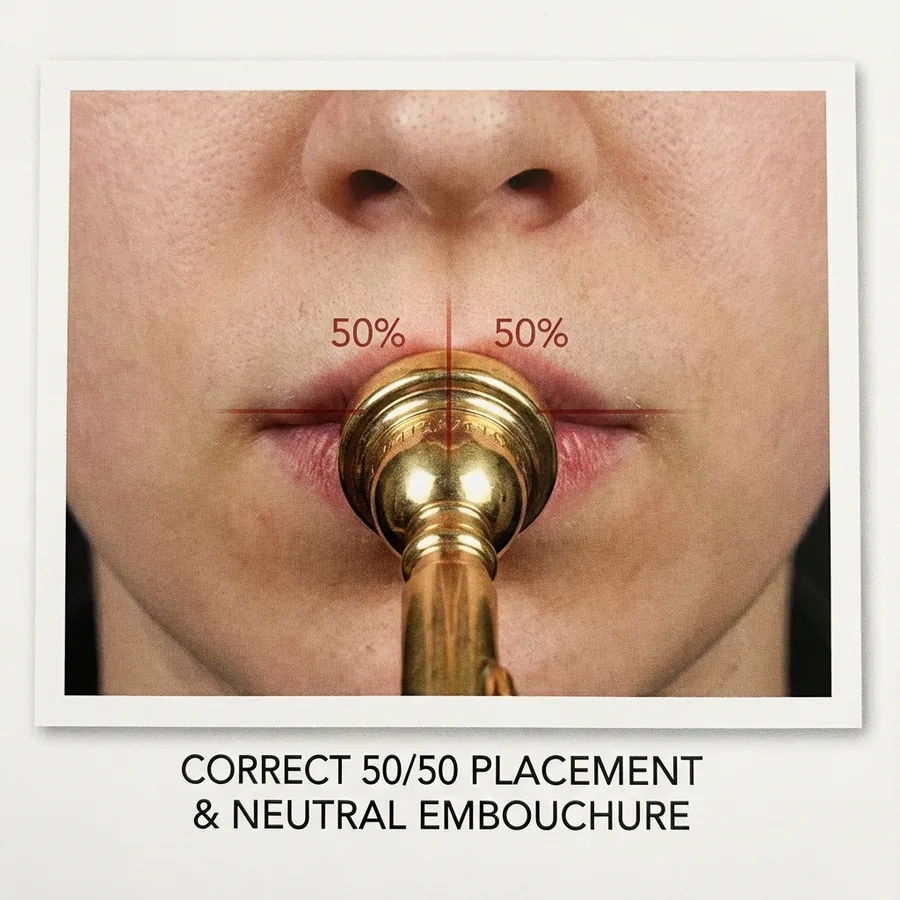
Now we combine the buzz with the amplifier. The mouthpiece placement determines your future success. We want a neutral, centered setup.
Vertical placement: Aim for 50/50 (half top lip, half bottom lip). Some players gravitate to 60/40 (more top lip), but avoid extremes like 90/10, as the top lip needs room to vibrate.
The Horn Angle
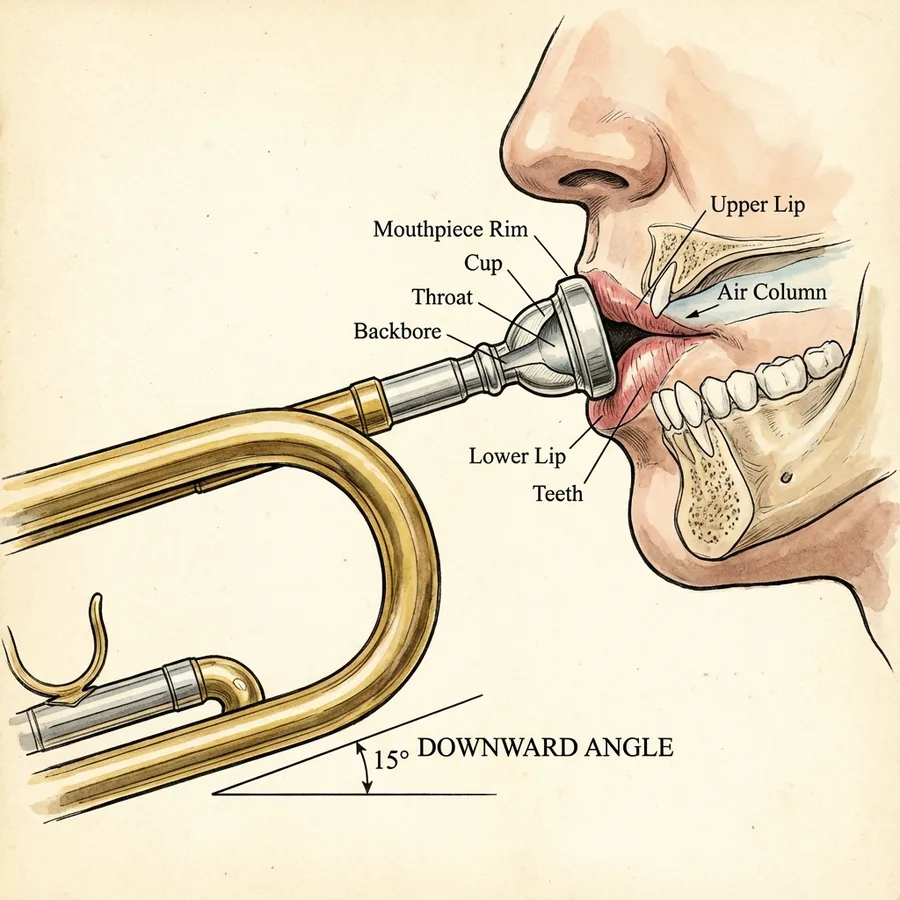
The trumpet should be an extension of your air stream. For most people, due to an overbite, the air stream goes slightly down.
Therefore, tilt the bell down about 10-20 degrees. If you hold the trumpet perfectly straight (parallel to the floor), you might be pinching off your top lip. Comfort is king.
The First Note: Second-Line G (G4)
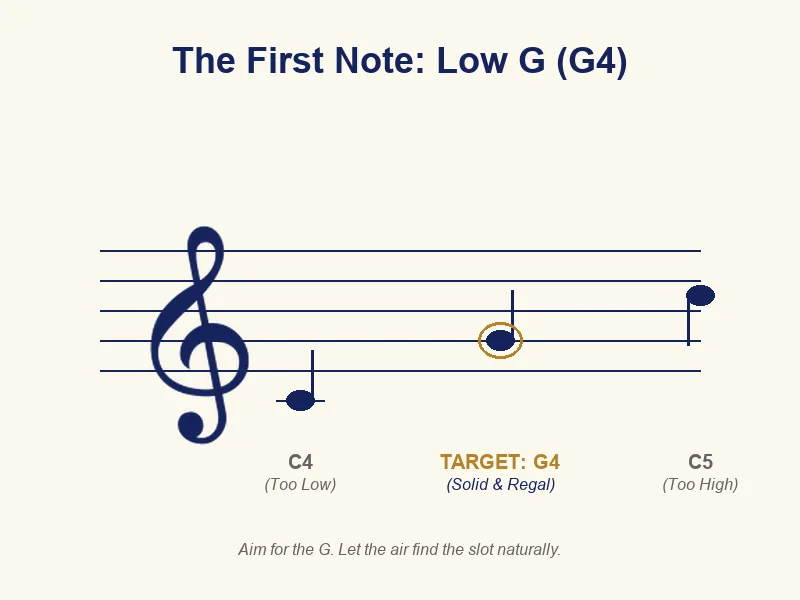
Finger 0 (No valves pressed). Take a big breath, set your 'M' embouchure, and release the air with a 'Too' attack.
Targeting: You are aiming for G4. It sounds solid and regal. If you hit strict low C (C4), relax slightly. If you hit high C (C5), relax A LOT.
Concept: Locking the Slot
The trumpet has resonant 'slots'. When you play right in the center of the pitch, the horn vibrates sympathetically with you. The sound becomes instantly fuller and easier.
Exercise: Play the G. Bend the pitch down slightly, then up. Find the 'sweet spot' where the tone blooms and rings the loudest with the least effort. Stay there. Determine to memorize that sensation.
Why "C" on Your Trumpet Sounds Like "B♭" on a Piano
Here is something that surprises every new trumpet player: when you finger and read a written C on your trumpet, the actual sound that comes out is concert B♭ — a whole step lower than a piano's C.
That's not a mistake. The trumpet is a transposing instrument. The vast majority of trumpets — including almost all standard student-model horns — are B♭ trumpets. The convention exists so trumpet, cornet, clarinet, and saxophone players can switch instruments without relearning fingerings: a written C is always played the same way, even though it sounds different on each instrument.
What This Means In The App
The notes you see on the score and the notes the app tells you you're playing are written pitch — the same notes you'd see on a trumpet sheet music part.
Behind the scenes, the microphone hears concert pitch (a whole step lower for a B♭ trumpet), and the app translates it back to written pitch so what you see lines up with what your fingers are doing.
Quick check: If you play your low C on the trumpet and a friend plays C on the piano at the same time, you'll hear a clash — they are NOT the same pitch. The piano is playing concert C; you are playing concert B♭.
Picking Your Trumpet Type
The app is configured for a B♭ trumpet by default. If that's what you play (or what you'll play — most student horns are B♭), you're already set. No action needed.
If you play a different trumpet — C, D, E♭, piccolo, etc. — open Settings → Trumpet Type and pick yours. The app will then translate written and concert pitch correctly for your instrument.
If you only have a mouthpiece right now, stick with B♭. The mouthpiece itself doesn't transpose anything, but training your ear in the B♭ trumpet's written pitch from the start will make the transition to a real horn seamless.